
Imagine receiving a brief for a 1,500-word article on IT outsourcing. The target audience is CTOs and IT managers. You have a primary keyword and a preliminary outline covering the topic and its benefits. There's a list of references and a call to action inviting readers to book a consultation.
Give that brief to three writers. One might explain the benefits of outsourcing. Another might compare outsourcing with in-house hiring. The third might write a guide to choosing a service provider.
All three could meet most of the production requirements. Yet each would be solving a different problem.
So what needs to be decided before you commission a piece of content?
A detailed brief can still send the writer in the wrong direction
A content brief communicates the direction and requirements for producing a specific piece of content. It contains two kinds of information that serve different purposes. Production requirements specify the deliverable: its format, length, keywords, deadline, and presentation standards. Strategic decisions establish why the content needs to exist, what problem it should address, what it should communicate, and what evidence supports its message.
Consider the outsourcing example again. If the goal is to help a CTO choose between hiring internally and outsourcing, the article needs to offer criteria for comparing costs, management capabilities, security requirements, and control over the project. An article listing ten benefits of outsourcing might meet the keyword and word count requirements without helping that CTO make a decision.
When the objective is unclear, the writer has to choose an approach. The editor may then assess the draft against an entirely different expectation. What follows may involve rebuilding the argument and structure rather than editing the prose. A good brief establishes a shared understanding of what the content needs to accomplish.
Five decisions to resolve before writing
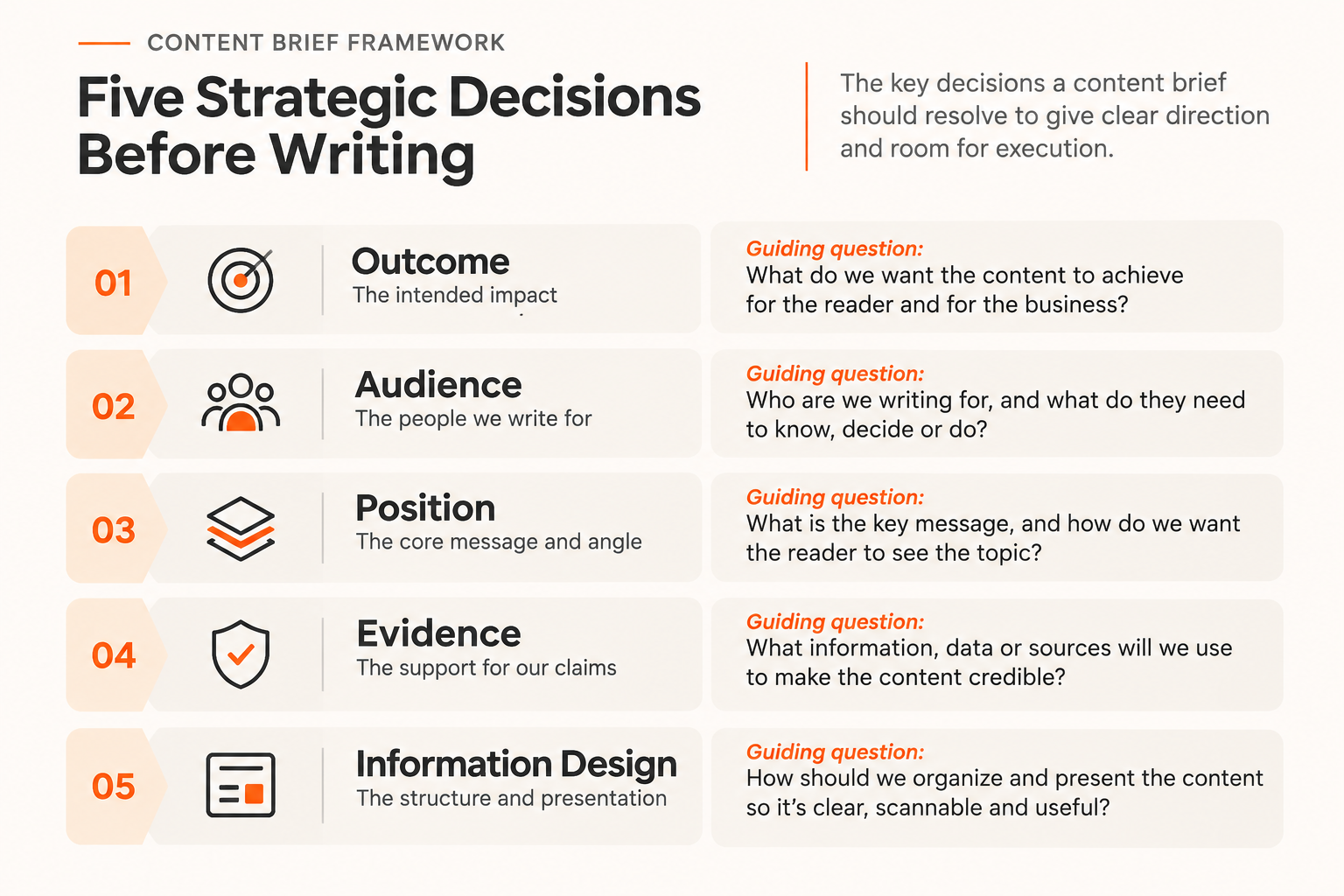
I propose organizing the decisions in a content brief into five groups. You can use them to build a new brief or assess the ones your team already uses.
Resolving a decision doesn't necessarily mean settling every detail in the brief itself. When further research is needed, establish who has the authority to make the decision, what evidence they need, and when the decision must be finalized.
Outcome: What should change for the reader?
Increasing brand awareness, attracting website traffic, and generating leads are all legitimate marketing goals. On their own, however, they offer too little direction for an individual article.
Define what readers should understand, reconsider, or be able to do after reading. For the IT outsourcing article, the desired outcome might be helping CTOs identify the conditions under which outsourcing would or wouldn't suit their businesses. That outcome is compatible with lead generation. It explains how the article contributes to a potential customer's decision before they contact the company.
Google's guidance also recommends creating content primarily for people rather than for attracting search engine traffic. SEO has a role to play, but it should serve that purpose. [1]
Audience: What problem are they trying to solve?
A CTO building a company's first product will have different questions from one managing a complex software infrastructure. A job title tells you who the reader is. Their circumstances tell you what information they need.
GOV.UK's content design guidance identifies user needs through the people involved, the tasks they need to complete, and the reasons behind those tasks. The UK's Office for National Statistics (ONS) also emphasizes grounding user needs in evidence rather than assumptions. [2][3] Although developed for public services, this approach can inform content marketing.
Instead of specifying “CTOs and IT managers,” a brief could identify technology leaders who need to expand their software development teams but haven't decided between hiring internally and outsourcing.
Search data, customer questions, conversations with sales teams, and direct interviews can help you investigate that need. Without such evidence, treat your audience definition as a hypothesis to test.
Position: What is the content trying to say?
The same topic can support several different arguments. A brief should establish which one serves the reader's needs and the content's objective. For the outsourcing article, a possible position is that comparing personnel costs alone is insufficient for choosing between in-house hiring and outsourcing.
This gives the writer a reason to examine management costs, security requirements, knowledge transfer, and control over the product. It also requires them to consider circumstances in which building an internal team would be the more appropriate choice.
Not every piece of content needs a provocative argument. A product tutorial may simply need to establish what users should understand and do correctly. What matters is having a central message that guides the selection of information.
Evidence: What can the content reasonably claim?
If a brief asks the writer to demonstrate that outsourcing reduces costs, establish the basis for that claim. Are we comparing direct personnel costs or the total cost of delivery? Does the comparison account for management, coordination, and knowledge transfer? The answer can change depending on what's included. A cost-saving figure shouldn't make its way into an article simply because it appears on a service provider's website.
A brief should identify acceptable sources, claims that require verification, and the limits of what the content can assert. Additional research can take place during production. But if missing evidence could change the central argument, resolve that issue before finalizing the article's direction.
Information design: In what order should readers encounter the information?
An outline should reflect the questions readers need answered. For the outsourcing article, a useful sequence might begin with the circumstances that prompt a company to expand its development capacity, followed by criteria for comparing the two approaches, their trade-offs, and how to choose between them.
Research by Nielsen Norman Group on web scanning behavior shows how descriptive, visually distinct subheadings help readers locate relevant information. [4] When organizing an article, identify which reader question each section answers. If a section exists only to accommodate another keyword, reconsider whether it belongs in the article.
What a good brief should leave to the writer
A clear brief doesn't need to prescribe every paragraph, example, or transition. When it dictates choices that have little bearing on the objective or accuracy of the content, it can limit the writer's ability to exercise professional judgment. More detailed instructions may still be appropriate when accuracy or consistency requirements are particularly strict.
Consider these two hypothetical briefs.
| Component | Brief A | Brief B |
|---|---|---|
| Outcome | Increase traffic and generate leads | Help readers evaluate two software development staffing models |
| Audience | CTOs and IT managers | CTOs deciding whether to expand their teams through hiring or outsourcing |
| Position | Undefined; the topic is the benefits of IT outsourcing | Personnel costs alone are insufficient for choosing a staffing model |
| Evidence | Online reference articles | Cost data with a clear calculation method, technical documentation, and information about management capabilities |
| Outline | Definition, benefits, and challenges | Selection criteria, trade-offs, and conditions for each approach |
| Next step | Book a consultation | Identify requirements and evaluation criteria before choosing a model |
| Writer's discretion | Unspecified | Choose examples, explanations, and the detailed structure |
| Requires confirmation | Unspecified | Cost figures, capability claims, and changes to the central argument |
Brief B gives the writer a clearer problem to solve. It still needs appropriate production requirements and actual sources before it can be considered complete.
I suggest distinguishing three categories of decisions:
- Agreed: Decisions about the objective, audience, message, and scope that the writer must respect.
- Delegated: Decisions the writer can make independently, including the opening, explanations, illustrative examples, and structural adjustments within the agreed direction.
- Require confirmation: Decisions that lack sufficient evidence or need approval from someone with the appropriate authority, such as product capability claims, customer data, or changes to the central argument.
The boundaries depend on the writer's expertise, the nature of the content, and the risks involved. A writer with industry expertise might be responsible for researching the topic and establishing the central argument. The brief should make that responsibility explicit. The writer still needs to settle the argument before developing a draft around it.
Delegating a decision doesn't mean it has been resolved. If an outstanding decision could change the direction of the article, whoever is responsible for it needs to settle it before drafting begins.
When is a content brief ready for production?
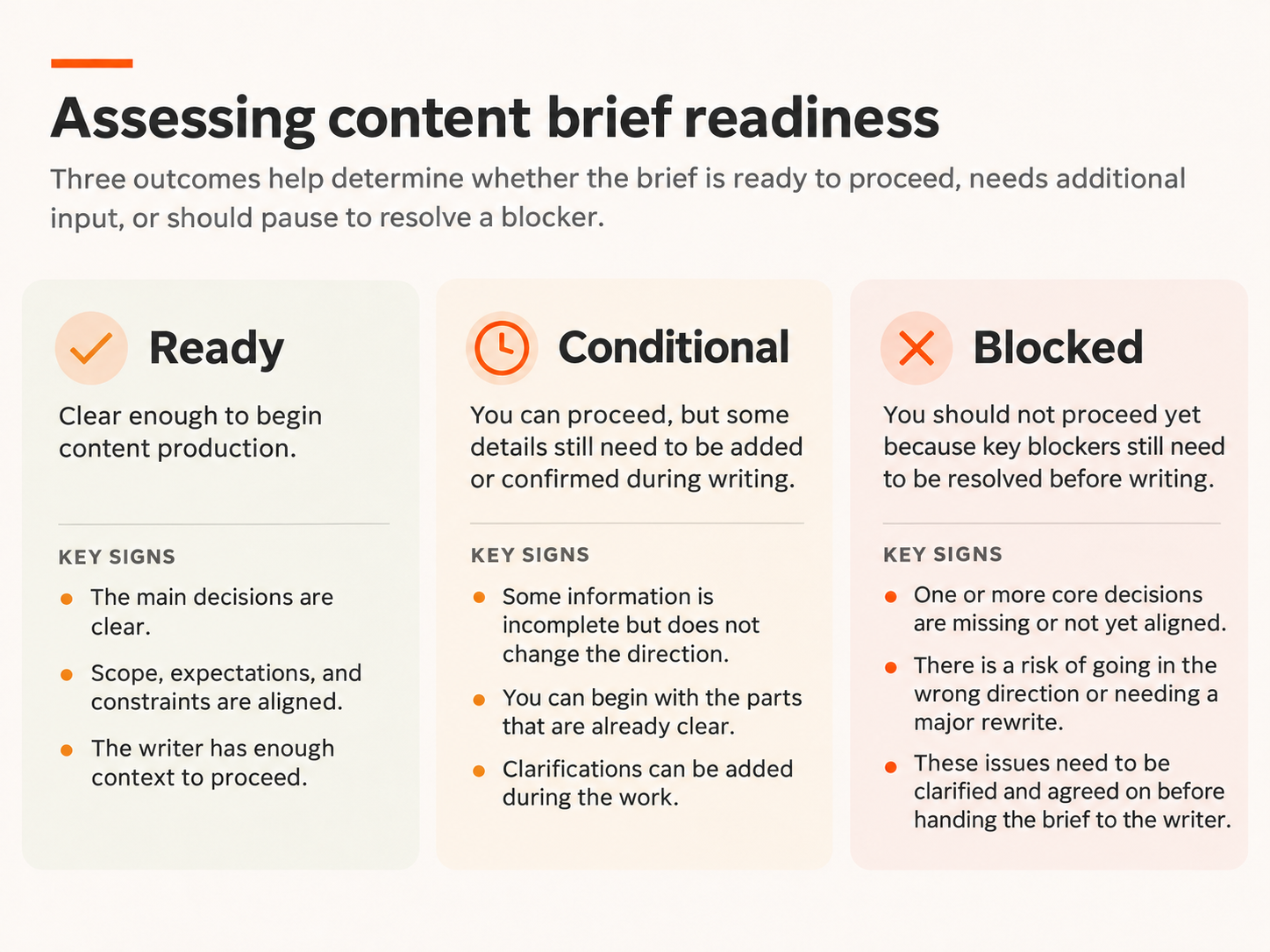
A brief is ready for drafting when its critical decisions are clear and adequately supported. Not every field needs to be complete. What matters is whether the missing information could change the direction of the article.
I suggest three statuses to assess readiness for drafting, rather than readiness to begin research.
| Status | Criteria |
|---|---|
| Ready | Critical decisions are clear and adequately supported. The writer can proceed within the agreed scope. |
| Conditional | The direction is clear, but some supporting information is outstanding. The writer can proceed with sections that don't depend on it. |
| Blocked | A decision or piece of evidence that could change the central direction is missing. Research can continue, but drafting should wait. |
Suppose the outsourcing article still needs an example of how two development teams coordinate their work. The writer can continue developing the other sections. But if the company wants to claim that outsourcing is always cheaper than hiring internally and lacks evidence to support that claim, the argument needs to be reconsidered before drafting.
Use these questions to assess your next brief:
- Is the desired outcome specific enough to guide the article?
- Have you identified the reader's needs and circumstances?
- Is the central message or argument clear?
- Are important claims adequately supported and appropriately qualified?
- Have you identified the questions the content needs to answer?
- Does the writer know which decisions they can make independently?
- Does each unresolved issue have someone responsible for addressing it and a point by which it must be resolved?
If the answer to any question is no, determine whether the issue affects the article's overall direction or only a particular part of it. Use that distinction to assign a readiness status.
| What's missing | How to address it |
|---|---|
| Outcome or audience needs | Clarify the direction before drafting. |
| Central argument | Assign research and argument development before drafting. |
| Critical evidence | Verify the claim, narrow its scope, or reconsider the argument. |
| Detailed outline | Let the writer propose a structure within the agreed direction. |
| Illustrative example | Continue with sections that don't depend on the example. |
| Decision-making authority | Establish who is responsible and when confirmation is needed. |
The five decision groups, delegation categories, and readiness statuses form a method I propose for assessing content briefs. It hasn't been empirically validated and isn't a standardized quality scoring system. A brief that satisfies six of the seven checklist items can still be blocked if the missing item concerns evidence for its central argument.
What to add to a brief when working with AI
When giving a brief to AI, specify how it should handle missing information and which decisions require human confirmation.
OpenAI's prompt engineering guidance discusses the use of instructions, relevant context, and output evaluation when building applications with language models. [5] In content production, the brief provides part of that context and direction. Imagine giving an AI model Brief A. It might produce a complete article about the benefits of IT outsourcing. But if the actual objective is to help CTOs evaluate two staffing models, a polished article doesn't establish that the task has been done correctly.
Brief B provides clearer direction, but it doesn't remove the need to verify sources, assess the reasoning, and edit the output. Specify whether the model should proceed within its assigned scope, propose options, or request human confirmation when information is missing. It shouldn't invent facts to make an incomplete draft appear finished.
The next time you build a content brief, read it from the perspective of the person receiving the assignment before adding another field. Are there any decisions that could change the direction of the article that you'd still have to guess at? If so, establish who should make those decisions and what evidence they'll need.
References
[1] Google Search Central. Creating helpful, reliable, people-first content.
https://developers.google.com/search/docs/fundamentals/creating-helpful-content
[2] GOV.UK. Identify user needs.
https://guidance.publishing.service.gov.uk/writing-to-gov-uk-standards/plan-manage-content/identify-user-needs/
[3] Office for National Statistics. Understanding your users: Identifying user needs.
https://service-manual.ons.gov.uk/content/writing-for-users/user-needs
[4] Kara Pernice, Nielsen Norman Group (2019). The Layer-Cake Pattern of Scanning Content on the Web.
https://www.nngroup.com/articles/layer-cake-pattern-scanning/
[5] OpenAI. Prompt engineering.
https://developers.openai.com/api/docs/guides/prompt-engineering